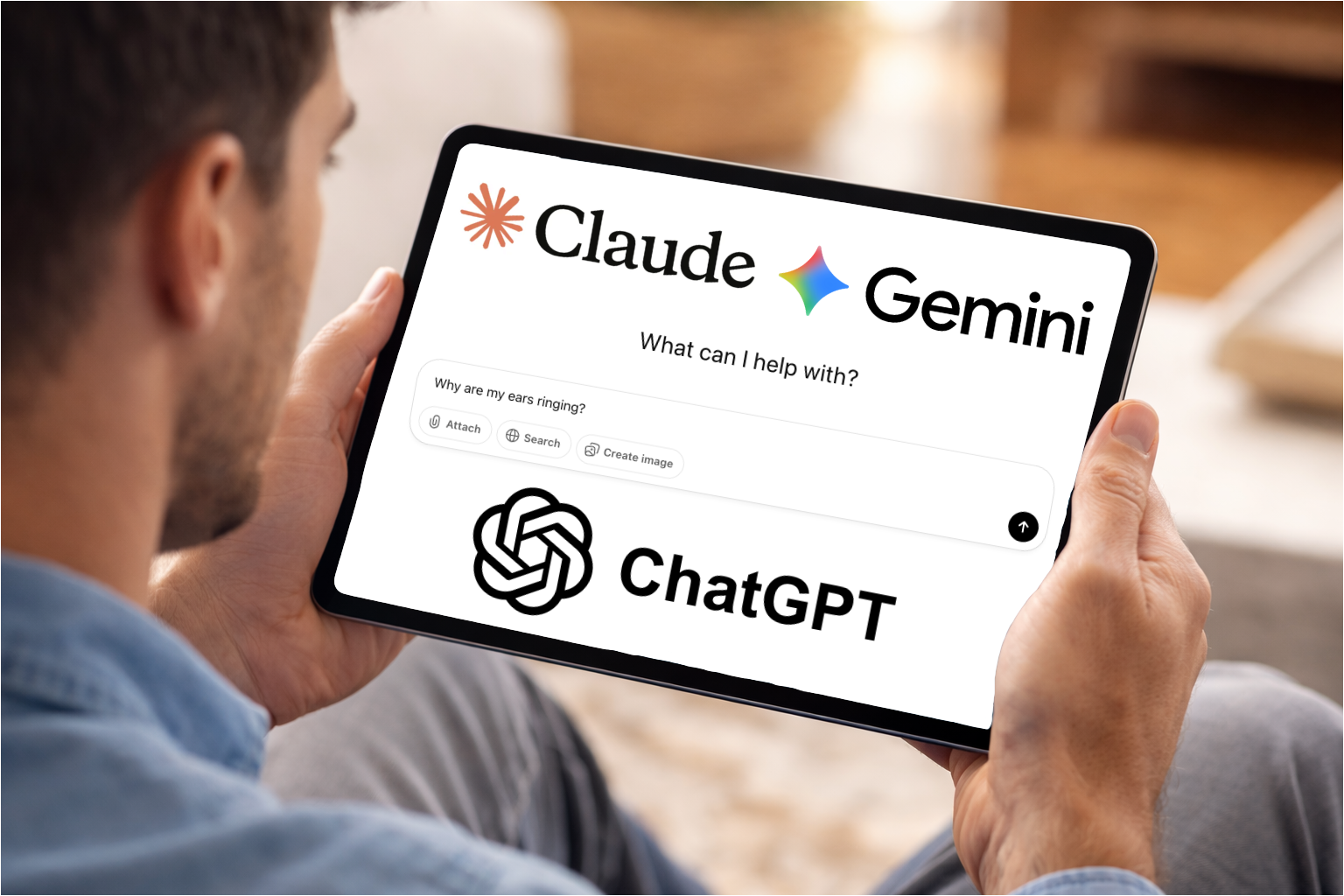
If you’ve searched for health information online recently, you may have noticed something new. Instead of just a list of websites, you’re often given a full answer at the top of the page. Tools like ChatGPT, Google’s Gemini, and other artificial intelligence platforms are changing how people look for medical information — including questions about hearing loss and tinnitus (ringing in the ears.)
So we decided to ask:
What Does AI Actually Say about Hearing Loss and Tinnitus?
The answers are interesting and encouraging — but incomplete.
AI Confirms That Tinnitus Can Be Treated
One of the most persistent myths is that tinnitus can’t be treated — that people just have to “live with the ringing.” The good news is that this isn’t true. At Hope Hearing and Tinnitus Center, we use a structured, personalized approach that combines sound therapy and counseling to help the brain habituate to tinnitus over time.
Interestingly, AI platforms like ChatGPT actually back this up. When asked about tinnitus treatments, AI acknowledges that while there may not be a single universal cure, structured and individualized approaches — including sound therapy and counseling — are the most effective ways to reduce tinnitus symptoms.
In other words, what we do at Hope Hearing and Tinnitus Center aligns closely with what AI research summaries identify as best practices.
AI can explain the principles behind tinnitus management, but it cannot tailor a program to your unique hearing profile or provide the hands-on guidance that TRT delivers. That’s why a professional evaluation remains essential for real, meaningful progress.
Who is Turning to AI for Health Answers?
It’s not just younger generations experimenting with technology. Many adults 40s+ are increasingly using AI tools because they offer something appealing: privacy, simplicity, and immediate answers.
Searching feels safe. It gives people time to understand what might be happening before talking to a professional. And that’s perfectly reasonable.
What AI Gets Right About Hearing Loss
When asked about hearing loss, AI provides surprisingly accurate information. It describes common experiences like difficulty hearing in background noise, needing others to repeat themselves, or turning up the television louder than others prefer. It notes that age-related hearing loss is extremely common and that untreated hearing difficulties can lead to social withdrawal and even cognitive challenges.
In many ways, that information is reassuring. AI translates medical research into everyday language that is easy to understand.
But AI cannot evaluate your hearing personally. It cannot measure your hearing levels, identify differences between ears, or determine whether medical evaluation is necessary. It explains patterns, not your specific situation.
What AI Says About Tinnitus
When someone types, “Why are my ears ringing?” AI typically describes tinnitus as a ringing, buzzing, humming, or cricket-like sound that others cannot hear. It usually explains that tinnitus is common, often associated with hearing loss, noise exposure, stress, anxiety, and that it is considered a symptom rather than a disease.
For those looking for tinnitus treatment or a hearing evaluation in the Dallas-Fort Worth area, this kind of information can be a helpful starting point — but it rarely replaces a personalized plan.
Importantly, most AI platforms now acknowledge that while there may not be a single universal cure, there are structured treatment approaches that can significantly reduce the burden of tinnitus. That’s encouraging, but it still only scratches the surface.
While There Is Good Info, AI Simply Can’t Go Deep Enough
AI can explain that tinnitus involves the auditory system and the brain. It can summarize research about stress, sound therapy, and counseling approaches. But it cannot design a personalized tinnitus management plan.
It cannot determine:
How intrusive your tinnitus is on a daily basis
Whether your auditory system needs amplification support
What sound therapy approach is appropriate
How counseling should be tailored to your specific triggers
How to adjust treatment over time as your brain adapts
And this is where structured therapies like Tinnitus Retraining Therapy (TRT) come in.
When is it Time to Move From Searching to Scheduling?
Artificial intelligence is a great tool for education. It helps people understand symptoms, break down myths, and feel less alone. But if you’ve been searching for the same symptoms repeatedly, or the ringing in your ears is becoming more intrusive, that’s usually a sign that information alone isn’t enough.
The next step isn’t another search. It’s clarity.
Hearing and tinnitus concerns are personal. Two people with similar symptoms may need very different solutions. The most meaningful progress comes when education turns into a personalized hearing/tinnitus evaluation.
In our office, we can develop an actual treatment plan that you can see, hear, and feel in real time — giving you a clear, hands-on understanding of your next steps.
If you’re ready to move from questions to answers, schedule a hearing and tinnitus evaluation with our team in Southlake. In this appointment, you’ll get a thorough hearing and tinnitus assessment, expert guidance, and a plan tailored to your unique needs. AI can provide information, but a professional evaluation gives you real insight and peace of mind — the first step toward better hearing and a more comfortable daily life.